
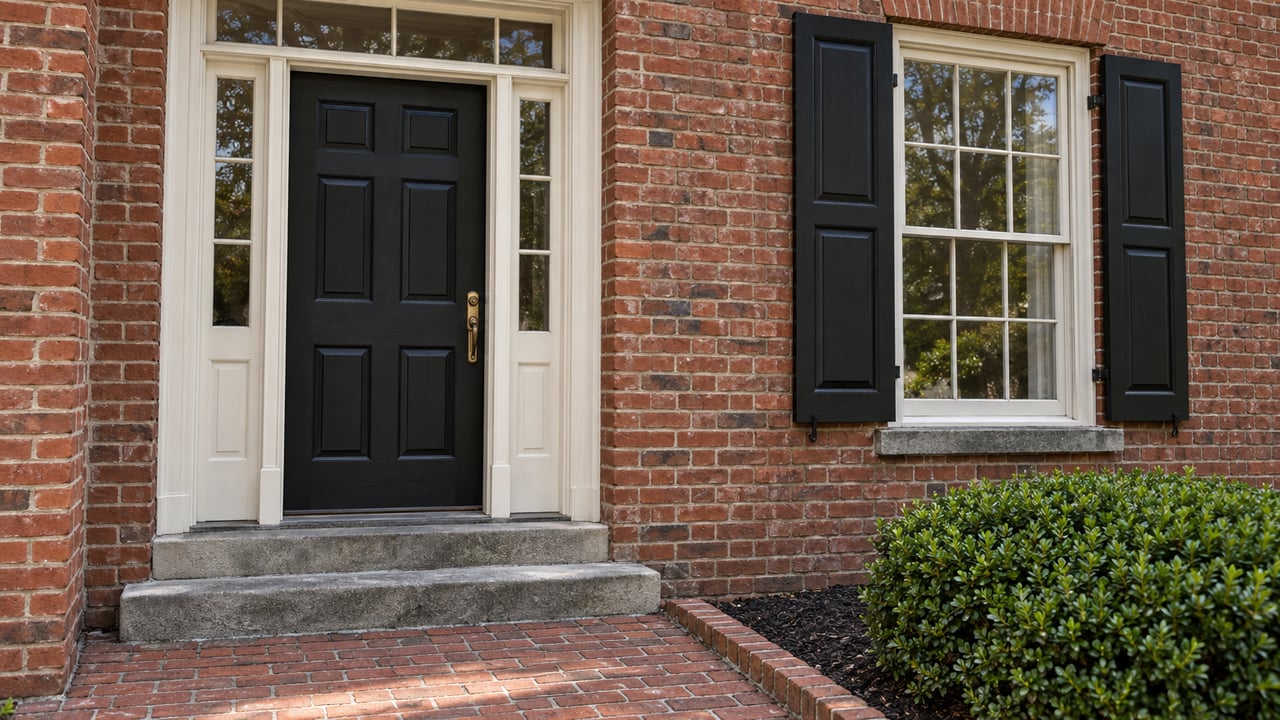
A buyer who closes on a downtown Leesburg home this fall and wants new windows will find that the Town's calendar sets the schedule. In the Old and Historic District, window and door replacement goes to the Board of Architectural Review as a public hearing. Under the Town's 2026 BAR schedule, an application filed by Monday, October 19 is heard on Wednesday, November 18. If it misses that deadline, the next hearing is December 16, and an application filed after November 16 waits until January 20, 2027.
Much of that waiting depends on one word in the Town's records. Each building in the H-1 overlay is classified as contributing or noncontributing. That classification decides which exterior projects Preservation staff can approve in the office and which ones go before the board at a monthly hearing. The label doesn't appear in a listing description. A Town survey could change it, and the list of approvals tied to it is part of a zoning rewrite that Town Council is scheduled to take up in December.
What a Certificate of Appropriateness actually covers downtown
The H-1 district is an architectural overlay. It governs how a building looks from the outside. It doesn't govern its use, parking, or anything inside, and it doesn't open a private home to the public. Its reach on the exterior is wide, though. The Town's Certificates of Appropriateness page says COAs are required "for all exterior alterations in the Old and Historic District (including in-kind replacement of material)."
The Town's 2009 Old and Historic District Design Guidelines do exempt true routine maintenance. That includes repairing broken windows while keeping as much original material as possible, partial in-kind repair of deteriorated roofing or siding, and repainting in the same color. The same page sets a firm limit: "Wholesale replacement of roofing material, windows or siding is not considered routine maintenance." A new roof, a full set of replacement windows, or new siding is a reviewed project, whatever the building's age or condition.
The next question is who does the review, and the contributing label answers it.
Where the label moves a project between staff and the board
Section 7.5.6 of the current Leesburg Zoning Ordinance, in its February 2024 edition, lets the Preservation Planner approve certain work without a public hearing or notice to neighbors. Separate lists apply to contributing and noncontributing structures. The Planning Commission draft of the rewrite, dated 06/16/26, keeps that structure in Sec. 7-1.G and changes some entries.
| Exterior work | Contributing, current ordinance | Noncontributing, current ordinance | Planning Commission draft |
|---|---|---|---|
| Like-kind roof replacement | Staff | Staff | Staff for both |
| HVAC units and support structures | Staff | Staff | Staff for both |
| Storm windows and doors | Staff | Staff | Staff for both |
| Like-kind porch columns or posts | Board; excluded from staff list | Staff for porch posts | Staff for both |
| Exterior doors | Board | Staff | Noncontributing: staff for like-kind replacement of "any major building element" |
| Solar panels | Not on staff list | Not on staff list | Staff for noncontributing only, side or rear elevation not facing public rights-of-way |
| Landscape walls | Staff up to 24 inches | Staff up to 24 inches | Staff up to 48 inches |
| Replacement windows and doors on a contributing building | Board | n/a | Board |
The bottom row stays the same in every version. Draft Sec. 7-1.H still sends "removal, replacement, or addition" of windows and doors, siding and cladding changes, porch and deck alterations, additions, new construction, and demolition to the board when they don't qualify for staff approval. For a contributing house, the rewrite makes porch repairs easier. It doesn't make window replacement easier.
Solar shows the gap between the two labels most clearly. The 2009 guidelines already say panels belong on secondary elevations and not on primary ones. Under the draft, the same side-yard array could be approved in the office for a noncontributing building and would still need a hearing for a contributing one.
What a board hearing adds to the schedule
Staff-level applications can be filed at any time and are reviewed in the office. Staff can also refer an application to the board if it doesn't meet the guidelines. The Town hasn't published a standard turnaround for those approvals. Board review follows a fixed sequence:
- File through eTRAKiT by the deadline, which falls about a month before each Wednesday meeting. Late applications move to the following month.
- Submit a complete package. A window application needs condition evidence for each window, plus dimensions, type, pane pattern, muntin details, material and color, and glass specifications. The Town warns that changes received after submission "may result in a deferral to a future meeting."
- Post the sign. Staff gives the applicant a sign to post on the property 15 days before the hearing, for a $10 fee, and mails a letter to adjacent owners 10 days before.
- Attend the 7 p.m. hearing. The board may schedule a work session or site visit if it needs one.
The board doesn't meet in August. Application fees are small. The Town's fee schedule lists $25 for alterations, $100 for additions, $50 for demolition and $500 for a new primary building. The page carries no revision date, so the Town is the source to confirm current amounts. The calendar costs more than the fees. A project that misses one deadline loses a month, and a project that misses the July filing loses the August recess as well.
A Town survey could change the label itself
Before the rules change, the classifications they depend on may change. The Town hired Stantec to survey the Old and Historic District starting December 9, 2024. It's the first survey in more than 20 years, and it was meant to record additions and alterations made since 2002. Before fieldwork began, the Town held information sessions at Town Hall, the Thomas Balch Library on West Market Street and the Donaldson Log Cabin on Loudoun Street SW. The Town's survey FAQ is direct about what could follow:
"New observations COULD impact whether your building is viewed as historically contributing or not contributing with the OHD."
The Town says it hopes to publish survey data on an online map and will at least give individual owners copies of their own records. That page gives no status after the survey's first rounds, so it doesn't say whether the survey is finished or whether the map is live. For now, a specific building's status comes from Preservation staff. Preservation Manager Lauren Murphy can be reached at [email protected] or (703) 771-2773. The Town's Historic Resources List isn't a building-by-building status list. It covers properties that could be added to the district later.
When the rewrite could take effect
Leesburg's last comprehensive zoning update was adopted in February 2003. Loudoun Now covered the draft's release for public comment, and the Planning Commission held its public hearing on April 16, 2026. Town Council finished its article-by-article sessions on September 21. Its posted schedule lists "deep dive" sessions on October 26 and November 9, a tentative session on November 23, a tentative public hearing on December 8 and tentative adoption on January 12, which falls in 2027 based on the order of the list. Those dates have already moved once. An earlier Council memo had a November 10 hearing and adoption on November 23. The draft's staff-approval list stays a proposal until Council adopts it.
Demolition and unapproved work carry the longest consequences
Under draft Sec. 7-1.K, an owner of a contributing building gets the right to demolish only after BAR approval and a bona fide offer to sell the property at a price reasonably related to fair market value. For property valued at $90,000 or more, that offer has to stay open for at least 12 months. The owner files a statement with the board before the offer begins. The current ordinance treats removing 40% or more of a building's exterior walls or roof as demolition. Smaller removals still need a COA as alterations.
Work done without a COA is a civil violation, and the Zoning Administrator is directed to take legal steps to stop it. The Town's posted Article 17 lists a $200 first fine and $500 for each additional violation, with a $5,000 cap before possible criminal prosecution. That text dates to 2012, so the Town is the source to confirm current amounts. Staff can also inspect finished work and require a new approval if it differs from the approved COA.
FAQ
Does H-1 status qualify a home for Virginia's historic rehabilitation tax credit? Not on its own. The Virginia Department of Historic Resources requires a "certified historic structure." That category covers a building listed individually, a contributing building in a registered district, and a building certified as eligible for listing. DHR's Part 1 application handles that certification, though DHR says an individually listed property with no outbuildings doesn't need one. The credit equals 25% of eligible rehabilitation expenses. Owner-occupied projects have to spend at least 25% of the building's prior-year assessed value, and the work must meet the Secretary of the Interior's Standards.
Is the H-1 district the same as the National Register district? No. The Leesburg Historic District, DHR 253-0035, was listed on the Virginia Landmarks Register in 1969 and the National Register in 1970, and its boundary was increased in 2002. The Town says that boundary and the local H-1 boundary are "slightly different."
Do fences need approval? Fences don't need a zoning permit, but in H-1 they need a COA, which staff can usually issue.
At Bill Davis, we build a downtown Leesburg home's contributing status and the next BAR deadline into a buyer's pricing and timeline before the contract is signed, and into a seller's pricing before the home is listed. If you own a home in the Old and Historic District, request your free home value report and we'll show how its classification and approval history shape what buyers will offer.
This article is general information, not legal, tax or financial advice. Consult a qualified professional about your situation.